Project overview
We developed an integrated and complete package of control and communications systems for three separate assets, two nearly identical minimum installation platforms and a floating production, storage and offloading (FPSO) unit, for twin conductor platforms located in Nigeria, West Africa. The brief included the development of the process control systems (PCS), safety instruments systems (SIS) and the low voltage motor control systems (MCC), including software and associated SCADA.
The challenge
Two complete platform control systems, including process control and integrated safety and fire and gas system, were required, alongside the design and supply of a new PAGA and VOIP system. The system had to be robust, simple and have low intervention and running costs, as its geographic location could prevent rapid change out of hardware components and their availability.
Scope of works
Each minimum installation asset had limited space on board, so consideration was needed for the selection of equipment and its layout, as looking at safety, access, operation, heat build-up and protection is important.
Each asset needed to have multi-bay control panels constructed with up to nine interconnected bays on the fixed assets and the inclusion of further accessory cabinets for servers and operations on the FPSO.
The PCS and SIS systems for the two assets and the FPSO were fully configured as a single integrated solution, providing complete communications across all three installations. They utilised a dual redundant configuration over Profinet and Profibus for optimum availability.

Asset one and two were similar with minor changes locally and were developed with:
- a low voltage motor control system (MCC)
- essential and non-essential distribution boards
- a process control system (PCS) and termination panel
- a safety instruments system (SIS) and termination panel
- a telecoms panel
- PCS and SIS software
Asset three, the FPSO, contained
- a PCS and termination panel and a SIS and termination panel
- a telecoms panel and a shutdown support panel
- a server cabinet (populated with SCADA server, OPC UA and associated switches)
- a EWS workstation and two OWS workstations
- two engineering laptops and a printer
- PCS and SIS software
- SCADA software and screen development
- SCADA redundant server configuration (Historian, domain control, storage etc)
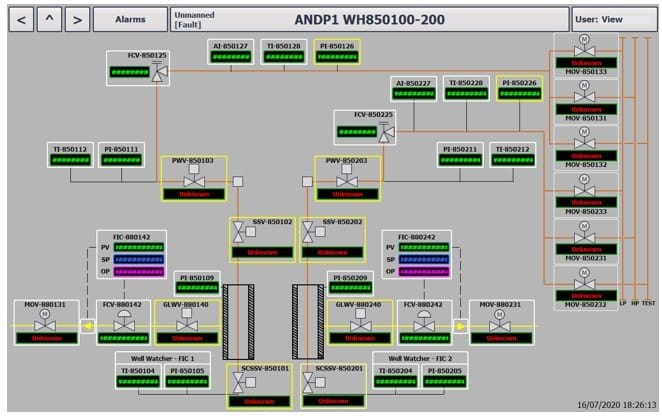
The SCADA software was specifically developed to communicate to the PCS and SIS nodes and provided a common operator interface for the FPSO.
Screens and displays were common for all assets, sharing features and layouts on the local asset HMIs and the FPSOs based control suit. The data provided by the SCADA system included alarms, events and Historian.
The software was designed to be expandable to support the client’s additional platforms and any future expansions.
The development of these systems also included:
- MCC and DCS for both platforms
- platform 1, 2 and FPSO PA and GA equipment
- platform 1, 2 and FPSO VOIP phone equipment
- configuration of the PA and GA and phone systems
- design engineering and design documentation
- FAT and SAT of above systems
- installation and commissioning
Conclusion
We used the Siemens platform of equipment, which is currently the most accessible hardware in the region and was client approved. As a Siemens Solution Partner, we delivered leading technical expertise to this project. The large scale fitted well within the capabilities of our multidisciplined approach to solution development, which included design, development, manufacture, testing and delivery.
We managed the project from our comprehensive facilities in Norwich, UK, and once it was shipped to Nigeria, we delivered the installation and commissioning with the client at the fabrication yard using our in-country collaboration team, Supanova Energy.
With projects this complex, we plan and work closely with our installation team. In this instance, we flew country engineers to the UK to familiarise themselves with the equipment and procedures prior to shipment. The team in Nigeria was supported by UK-based engineers via IT technology and direct communications, delivering within the exacting parameters of our client.
For all systems designed and installed, the project was completed on time and within budget.
Our broad engineering disciplines span all aspects of a complex project such as this. From the regular MCC panels, control room SCADA software and safety systems all the way through to telecommunications systems, we can deliver a comprehensive solution to meet your needs.